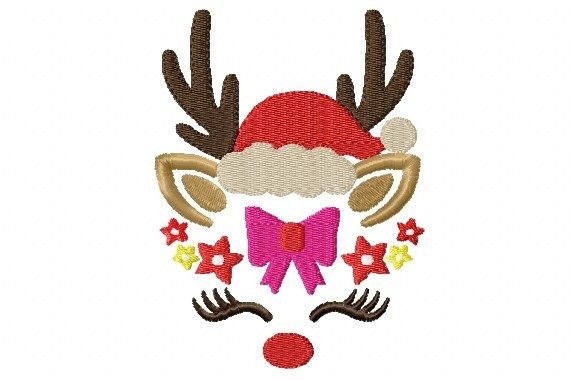
Christmas Girl Reindeer with Stars
A Playful, Warm First Impression—Not Just Another Holiday Clipart
When I opened Christmas Girl Reindeer with Stars for the first time, I didn’t see a generic holiday motif—I saw a character. There’s softness in the curve of her cheek, gentle spacing between the stars, and a subtle asymmetry in her antlers that reads handmade, not algorithmic. This isn’t a stiff vector redraw; it feels like a design drawn by someone who sketches reindeer doodles on coffee-stained napkins. That warmth matters—especially when you’re stitching a baby onesie or embroidering a boutique apron where charm carries as much weight as craftsmanship.
Where It Shines: Real Projects, Real Customers
Last week, I stitched Christmas Girl Reindeer with Stars onto a natural linen tote bag for a local gift shop’s holiday pop-up. The result? A friendly focal point—neither too cutesy nor overly literal. Customers paused, smiled, and asked, “Is that a girl *and* a reindeer? How sweet!” That reaction tells me something important: this design communicates joy without shouting. It works especially well for products where personality meets practicality—think embroidered sweatshirt cuffs, tea towel hems, or pillow covers for a cozy nursery. As a machine embroidery design, its balance of open space and defined shapes keeps stitch time reasonable while preserving readability at 3–4 inches wide.
I also tested it on a lightweight cotton-blend cap—a tricky surface. The stars held up cleanly thanks to moderate stitch density and thoughtful placement away from the curved crown seam. No puckering, no thread breaks. For Etsy sellers bundling digital embroidery files, this is gold: buyers get a design that behaves across common small-business applications—custom apparel, embroidered patches, personalized gifts—without requiring advanced digitizing tweaks.
Where to Pause—and Why
Christmas Girl Reindeer with Stars isn’t built for every fabric or function. On thin or highly stretchy knits (like ribbed baby bodysuits), I recommend testing stabilizer layers first—especially under the face and antler tips, where fine satin stitch details could shift. Dense fill areas around the dress hem may need light tear-away + cut-away combo stabilizer on textured fabrics like terry cloth or bouclé. And if you’re planning dark fabric backgrounds, check how the star outlines read in your thread colors: subtle metallics or light pastels can vanish unless contrast is intentional.
Also worth noting: the design’s gentle curves and rounded features don’t translate well to ultra-small hoop sizes (under 3 inches). Tiny versions lose the expressive eyes and star clarity—critical for items like keychain patches or mini ornament appliqués. If you’re designing printable mockups for your Etsy listing, render it at 4” and 5” widths to show scale honestly. Don’t oversell the tiny version—it’ll mislead buyers and hurt your shop’s trust score.
What It Adds to Your Finished Product—Beyond Stitches
This isn’t just decoration—it’s emotional shorthand. When stitched onto a handmade baby blanket, Christmas Girl Reindeer with Stars reads as tender, nostalgic, and quietly confident—not saccharine. That tone elevates perceived value. Customers pay more for pieces that feel considered, not assembled. For craft businesses, that means better margins on holiday embroidery projects. For apparel decorators, it means repeat orders from boutique clients who want cohesive, brand-aligned seasonal collections—not one-off clipart.
It also supports professionalism in subtle ways. The balanced negative space gives breathing room on busy fabrics (like striped tea towels or plaid flannel). No visual crowding. No awkward cropping. And because the composition avoids tight corners or micro-lettering, it scales reliably across product types—from oversized pillow covers to compact cap fronts—without needing multiple file versions.
Practical Designer Notes Before You Stitch
- Always test on scrap fabric first—especially if using textured, dark, or stretchy materials.
- Review thread color contrast before finalizing—what reads cheerful on white may disappear on navy or charcoal.
- Check stitch density against your machine’s capabilities and your project’s durability needs (e.g., high-wear items like tote bags benefit from slightly denser fills).
- Confirm hoop size compatibility—this design fits comfortably in a 4x4 hoop but may require repositioning for tighter caps or curved seams.
- Inspect small details in your embroidery software: are the star points sharp? Do the eyes hold shape after stitching? Zoom in.
- Test black-and-white mockups to assess silhouette strength—great for social media thumbnails and printed catalogs.
- Compare light and dark fabric backgrounds in your design preview—some thread combos look warm on cream but cold on black.
- Use proper stabilizer: medium-weight cut-away for stable wovens; lightweight tear-away + topping for knits.
- Verify licensing terms before selling finished items or bundling the digital embroidery file—commercial use isn’t automatic.
Final Thought: A Design That Earns Its Place
Christmas Girl Reindeer with Stars doesn’t try to be everything. It’s not a maximalist tree topper or a glitter-bombed sweater statement. It’s a quiet, confident choice—for the maker who values intention over impulse, clarity over clutter, and charm that lasts beyond December 26th. Whether you’re prepping holiday embroidery projects for your small shop, building a curated Etsy collection, or personalizing gifts with care, this design earns its spot by working well, reading warmly, and stitching cleanly. That’s not just holiday magic—that’s good design judgment.