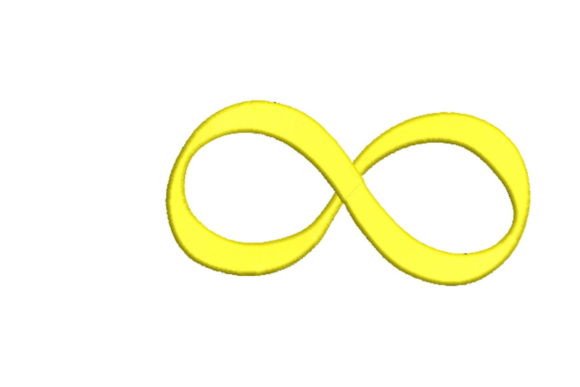
Infinity: A Quietly Powerful Shape for Real Embroidery Work
Let’s be honest—I opened the Infinity embroidery file not expecting much. “Shapes” is a crowded category, and “infinity” can easily slip into cliché territory: overused, overly symmetrical, or worse—flimsy in stitch execution. But after stitching it on three different fabrics (a cotton twill tote, a baby-soft organic onesie, and a structured wool-blend cap), I paused. Not because it was flashy—but because it *worked*. Cleanly. Quietly. Consistently. That’s rare. And that’s why Infinity deserves your attention—not as filler, but as intentional design.
First Impressions: Minimalism with Weight
The shape itself is a single, continuous loop—no breaks, no corners, no decorative flourishes. It’s drawn with confident curvature, balanced in proportion, and scaled to sit comfortably between 1.5" and 2.5" without distortion. There’s no applique design layered in, no satin-stitched border shouting for attention. Instead, it relies on smooth fill stitch transitions and thoughtful stitch density: dense enough to hold its form on lightweight fabric, open enough to avoid puckering on knits. It feels calm—not cold, not sterile—like something you’d choose for a nursery mobile or a linen tea towel meant to last years.
Where It Shines (and Why Your Customers Will Notice)
I used Infinity as a subtle chest accent on a custom embroidered tote bag for a local bookstore—just above the pocket, stitched in muted charcoal thread on oat-colored canvas. No logo, no text. Just the shape. Customers kept asking, “What does that mean?” Not because it was confusing—but because it felt *intentional*. That’s the quiet power of a well-executed shape: it invites pause, not explanation.
It performs equally well across real-world applications:
- Sweatshirt embroidery: Stitches cleanly over fleece backing when paired with medium-weight cutaway stabilizer—no shadowing, no distortion at the curve.
- Baby embroidery: On a 100% cotton onesie, the low stitch count and gentle curves avoided stiffness—critical for delicate skin and frequent washing.
- Embroidered patch: Hooped with tear-away and lightly fused to twill, it held crisp edges even after being sewn onto a denim jacket sleeve.
- Holiday embroidery: Stitched in metallic gold on dark green velvet napkins? Elegant, not kitschy—ideal for wedding favors or boutique holiday collections.
- Etsy seller asset: As a standalone digital embroidery file, it pairs effortlessly with monograms or minimalist text—no clashing, no visual competition.
This isn’t just decoration. It’s a brand anchor—a small, repeatable motif that builds recognition across tote bags, pillow covers, aprons, and even printable mockups for your shop listings. For craft business owners, that consistency matters. It tells customers you’ve curated, not just assembled.
Where to Proceed With Care
Infinity is versatile—but not magic. Here’s where judgment matters:
- Curved surfaces like caps: The continuous loop handles gentle curves beautifully, but avoid placing it directly over the crown seam unless you’ve tested hoop placement and tension on your specific cap frame.
- Thin or stretchy fabric: Use a light stabilizer blend (tear-away + light iron-on) to prevent pull distortion—especially near the inner curve where tension concentrates.
- Dark fabric + light thread: The design’s clean edges make it ideal for contrast, but test thread color first. A pale ecru reads softer than stark white; a deep navy thread on black creates subtle dimension without fading.
- Tiny hoop sizes: Below 2", details hold—but check the inner curve in your embroidery software. Some machines compress small loops; zoom in before finalizing.
- Frequent-wash items: Avoid high-density fill in the center if stitching for baby blankets or kitchen towels. A slightly more open stitch pattern improves flexibility and longevity.
Design Notes You’ll Actually Use
As someone who’s shipped hundreds of finished products—and scrapped just as many test runs—here’s what I did with Infinity, and what I recommend you do too:
- Test on scrap fabric first—not just for stitch-out, but for how it feels to the touch. Does it lie flat? Does the curve snag? Does it look handmade, or mass-produced?
- Review stitch density in your editing software. If you’re layering it near text or another motif, ensure no overlapping stitches cause buildup.
- Confirm hoop size compatibility before prepping a client order. Even small shapes can push limits on compact hoops.
- Inspect small details at 200% zoom—especially the junction where the loop meets itself. A clean join signals quality digitizing.
- Test black-and-white mockups before listing on Etsy or sending to a print-on-demand partner. Shapes live or die by silhouette clarity.
- Use proper stabilizer—not just “some.” Match it to fabric weight and end use. A baby onesie needs different support than a canvas apron.
- Check licensing terms before selling finished items or bundling Infinity into a larger digital embroidery collection. When in doubt, contact the creator.
Final Thought: It’s Not Just a Shape—It’s a Design Decision
In a world of busy patterns and loud branding, Infinity stands out by stepping back. It doesn’t shout “look at me”—it says “this is considered, this is made well.” That subtlety translates directly to perceived value: a $38 embroidered pillow cover feels worth it when the motif is precise, balanced, and quietly meaningful. For Etsy sellers, that’s conversion. For boutique owners, it’s cohesion. For parents choosing a personalized gift, it’s trust.
Yes, it’s a shape. Yes, it’s an embroidery file. But used with intention—on the right fabric, at the right scale, with the right thread—it becomes part of the story your handmade product tells. And that’s why, after years of reviewing hundreds of designs, I’ll keep Infinity in my active folder—not as background filler, but as a go-to element of calm, confident design.